
SCOLIOSIS
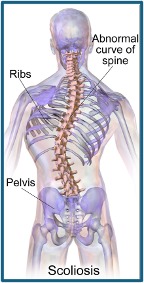
Scoliosis is a sideways curvature of the spine, often with some rotation of the vertebrae. When it appears in adolescents (typically ages 10–18) with no identifiable cause, it’s called Adolescent Idiopathic Scoliosis (AIS) — the most common type of scoliosis, accounting for about 80% of cases. A curve is generally diagnosed as scoliosis when it measures 10 degrees or more on an X-ray (using the Cobb angle method).
Causes
Even though the most common reason is idiopathic its often a mix of various causes like
- Genetics – scoliosis often runs in families
- Hormonal and growth factors – onset frequently coincides with growth spurts
- Neuromuscular and connective tissue factors – subtle differences in muscle balance or bone growth may play a role
Symptoms
Usually scoliosis is asymptomatic with only cosmetic concerns predominantly as
- Uneven shoulders or shoulder blades (one appears more prominent)
- Asymmetric waistline or hips
- One side of the rib cage sticking out, especially when bending forward (rib “hump”)
- Leaning slightly to one side
Rarely severe scoliosis especially in young children can cause respiratory compromise and in adults cause back pain
Diagnosis
Generally scoliosis is a clinical diagnosis picked up by assessments.
Forward bending test ( adam’s test) is a simple screening test for scoliosis .
Its further confirmed by taking
- Xrays – whole spine , supine side bending and traction views
- MRI scan – to assess the neurological developmental compromise
- CT scan – to assess the curvature and plan the placement of implants in deformity correction surgery
Treatment — Based on Curve Severity and Growth Remaining
| Curve Size | Typical Approach |
| Under 20° | Observation with periodic X-rays every 4–6 months to monitor for progression |
| 20°–40° (and still growing) | Bracing (e.g., Boston brace, worn 16–23 hours/day) to prevent progression |
| Over 40°–50° | Surgery (typically spinal fusion) is often recommended, especially if the child still has significant growth remaining |
- Physical therapy / specific exercise approaches (like the Schroth method) are sometimes used alongside bracing, though evidence on standalone effectiveness varies
- Risk of progression depends heavily on how much growth remains — curves tend to worsen most during the adolescent growth spurt and are less likely to progress after skeletal maturity (often assessed via the Risser sign on X-ray or hand/wrist bone age)
- Surgery (spinal fusion with rods and screws) aims to stop progression and correct the curve; it’s a major but generally well-tolerated procedure with good long-term outcomes
Fusion surgeries
- Generally posterior fusion surgeries with implants are chosen and the extent of correction depends on the severity of the curve, extent of curve, compensatory curve nature and further growing potential of the child
Our Services
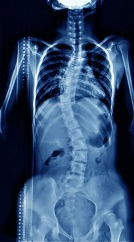
PRE OPERATIVE XRAY
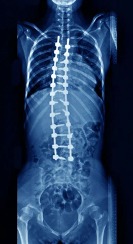
POST OPERATIVE
XRAY – CORRECTED
- Severe scoliotic curves >90 degrees curve and rigid curves may need anterior and posterior surgery where anterior column is released by doing selective total discectomy and fusion across the segments, followed by posterior traditional fusion surgery .
- Fusionless surgery – anterior column detethering surgery with implats has a limited role in growing spine to correct the deformity maintaining the flexibility of spinal column.
Prognosis
- Most curves are mild and never require more than monitoring
- With appropriate bracing, progression to surgical thresholds can often be prevented
- Adults who had AIS as teens generally lead normal, active lives; scoliosis itself is not typically life-limiting unless curves are very severe and affect lung function
- Curves can sometimes progress slowly in adulthood, so some people benefit from occasional follow-up even after skeletal maturity
Spine oncology , Geriatric spine care , Minimally invasive spine surgery , Navigated spine surgeries.
+91 80127 91565
krbarani@gmail.com
Quick Links
Copyright 2022-2024 by Dr.Barani Rathinavelu | All rights reserved.
Copyright 2022-2024 by Dr.Barani Rathinavelu | All rights reserved.